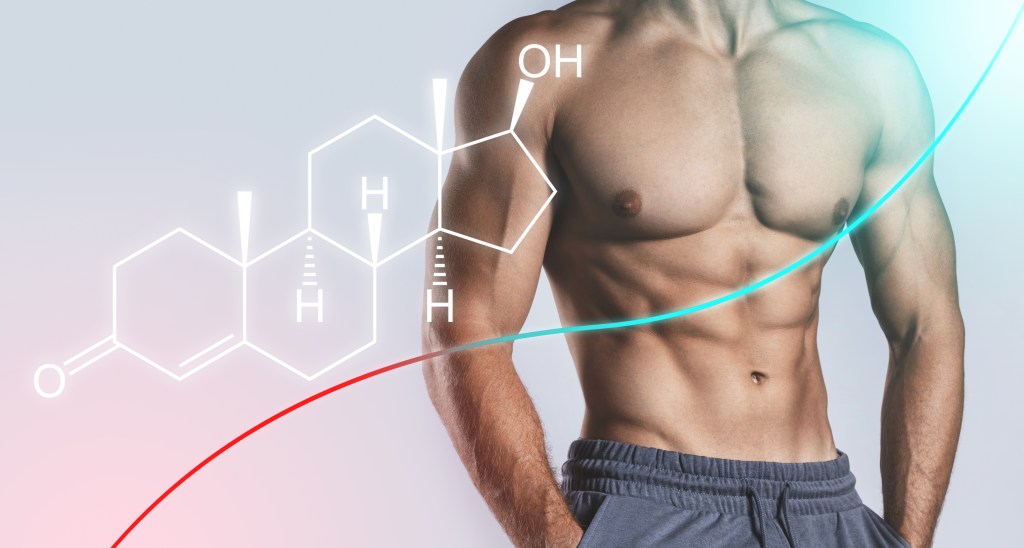
What is testosterone?
Testosterone is a sex hormome. Its functions are to produce muscle mass and bone mass as well as produce red blood cells. It can control your brain including libido, motivation, and cognition. And it can also control your genital such as erection and sperm production.
Where does testosterone come from?
Testosterone is secreted form gonads, which are two stuctures besides the penis. Its functions are controlled by the higher structures in the brain, namely pituitary and hypothalamus.
Hypothalamus secrete GnRh (gonadotropin releasing hormone) into the pituitary, after that pituitary will secrete LH (lutenizing hormone) and FSH (follicle stimulating hormone) into the blood stream. At the testes, there will be LH receptors that sense the stimulants and will secrete testosterone respectively. This three-layers system is called hypothalamic-pituitary-gonadal axis. We also have the loop that control the optimal level of testosterone. If testosterone is too low, the hypothalamus will sense that and produce higher GnRh. On the contrary, if testosterone is too high, the Hypothalamus will produce less testosterone. This loop is called negative feedback.

(joshya/shutterstock.com)
What is low testosterone?
Low testosterone occur in older people. It can be caused by declining function of the testes due to to aging. This can also be caused by defects at the hypothalamus or pituitary as well.
The symptoms of low testosterone could be somewhat specific such as erectile dysfunction or loss of libido. It can also be nonspecific symptoms, including irritibility, depression, loss of attention, low muscle strength, or low muscle mass.
How can we detect low testosterone?
We can test our testosterone in our blood. You should get in the test in the morning due to diurnal variation of the testoserone and it will be at the high level at that time.
Before get the test. You should be fasted because food and glucose can suppress your testosterone level. It is recommended to get the test two times for reliability.
What is SHBG?
SHBG stands for sex hormone binding globulin which is bound to testosterone. Most testosterone in our body is bound to proteins about 50% with albumin and 40% with SHBG. The binding to the SHBG is very thight but it is loose with albumin. There is about 2% of testosterone in free form which is the active one. We have the bound form of the hormone for the preserverance reason.

There are some conditions that can change SHBG level which can impact the level of testosterone as seen in the table below.
Decreased SHBG
Diabetes Mellitus
Obesity
Nephrotic syndrome
Glucocorticoid, progestin and androgen
Hypothyroidism, untreated
Acroomegaly
Familial SHBG deficiency
Polymorphism in SHBG gene
Increased SHBG
Aging
Hepatic cirrhosis and hepatitis
Esotrogen
Hyperthyroidism, untreated
Anticonvulsants
HIV disease
Polymorphism in SHBG gene
What is normal testosterone?
Normal total testosterone is defined as >300 ng/dl. This test should be done with low tesoterone symptoms.
Free testosterone and SHBG are not routinely measured due to no conclusive evidence of benefits. Additionaly, the tests have availability abd variability problems. The tests could be done in case of suspected conditions that might effect SHBG or total testosterone results in low normal range.
Is there any other tests to that could be done?
If you have low testosterone, measuring LH should be done. It could be the problem at your pituitary that it does not function properly and cause the problem.
Hematocrit which is a concentration of your red blood cells, is recommened to test before recieving TRT (testosterone replacement therapy). The treatment could cause higher hematocrit and can cause problems with blood clots. If you have >50% of hematocrit, you should stop the treatment and find out the cause.
PSA (prostate-specific-anitigen) is done for prostate cancer screening. Although, there is no evidence that TRT can cause prostate cancer, this is a precaution from the experts’ opionin.
How can we treat low testosterone?
We usually recommend intramuscular injection for the treatment. Testosterone enanthate and cypionate are the short acting forms. They are given 1-2 times a week. Their benefit is easily adjustable, but they can cause the drug fluctuation in your blood in a first few days which can cause some symptoms such as irritibility or flushing.
There is the long acting form, namely testosterone undecanoate. This drug can be given once a month. Its benefits include the stability of drug in your blood, but it has to be injection in high volume each time (3-4 ml).
Testosterone cream can be used. This form can adjust doses easily and can be wiped out. It has less effect to the hematocrit but it can be transfered by touching. If you touch women or kids, they might experience symtpoms of adverse testosterone.
Testosterone implant has benefit of less clinic visits. It need to change every 3-6 months, however, you need surgical procedure to put it under your arm.
Lastly, you can take testosterone tablets. This form is very convenient, but it is poorly absorbed due to liver metabolism. It can also cause liver toxicity.
What are precuations undergoing TRT?
If you are considering to have kids, exogenous testosterone can cause lowe sperm count. This could take 1-2 years for sperm count to come back to normal.
Polycythemia is a condition that you body has too much red blood cell concentration. If hematocrit is >54%, your doctor might decrease the testosterone dose due to the risk of blood clots that can lead to serious problems.
You can also experiece hair loss, oily skin, acne and worsen sleep apnea.
How can we follow-up after TRT?
You should follow-up after 3-6 months of the treatment and could extend to 6-12 months if you have stability of testostone in your blood. These visits should include hematocrit and PSA testing.
You should consider stop using TRT, if your symptoms do not improve in 3-6 months, despite your testosterone in normal. Because your symptoms could be from other conditions, that is not related to low testosterone.
How can we improve our testosterone without medications?
You should eat enough cholesterole, because testosterone is produced from cholesterol. Low fat diet can cause lowe testosterone. You should also consume enough calories for your body and activity. If you are in calorie deficit state, your body cannot produce enough testosterone. Minerals including Zinc, Magnesium, and vitamin D are essentals for testosterone production. Make sure that you take appropriate amounts of these.
Besides food, you can improve your testosterone by loosing weight if you are obese. Resistant exercise can help imrpove your testosterone, especially training in the big muscles such as chest, back, or thigh. You should sleep adequately which take about 7-9 hours. Sleep can help normalizing testosterone level.
References:
Nassar GN, Leslie SW. Physiology, Testosterone. [Updated 2023 Jan 2]. In: StatPearls [Internet]. Treasure Island (FL): StatPearls Publishing; 2024 Jan-. Available from: https://www.ncbi.nlm.nih.gov/books/NBK526128/.
Melmed S, Koenig R, Rosen CJ, Auchus RJ, Goldfine AB. Williams Textbook of Endocrinology, 14th edition. Elsevier; 2019.
Mulhall JP, Trost LW, Brannigan RE, et al. Evaluation and Management of Testosterone Deficiency: AUA Guideline. J Urol. 2018;200(2):423-432. doi:10.1016/j.juro.2018.03.115.
Whittaker J, Wu K. Low-fat diets and testosterone in men: Systematic review and meta-analysis of intervention studies. J Steroid Biochem Mol Biol. 2021;210:105878. doi:10.1016/j.jsbmb.2021.105878
Smith SJ, Teo SYM, Lopresti AL, Heritage B, Fairchild TJ. Examining the effects of calorie restriction on testosterone concentrations in men: a systematic review and meta-analysis. Nutr Rev. 2022;80(5):1222-1236. doi:10.1093/nutrit/nuab072.
Prasad AS, Mantzoros CS, Beck FW, Hess JW, Brewer GJ. Zinc status and serum testosterone levels of healthy adults. Nutrition. 1996;12(5):344-348. doi:10.1016/s0899-9007(96)80058-x.
Smith SJ, Teo SYM, Lopresti AL, Heritage B, Fairchild TJ. Examining the effects of calorie restriction on testosterone concentrations in men: a systematic review and meta-analysis. Nutr Rev. 2022;80(5):1222-1236. doi:10.1093/nutrit/nuab072.
Pilz S, Frisch S, Koertke H, et al. Effect of vitamin D supplementation on testosterone levels in men. Horm Metab Res. 2011;43(3):223-225. doi:10.1055/s-0030-1269854.
Fui MN, Dupuis P, Grossmann M. Lowered testosterone in male obesity: mechanisms, morbidity and management. Asian J Androl. 2014 Mar-Apr;16(2):223-31. doi: 10.4103/1008-682X.122365. PMID: 24407187; PMCID: PMC3955331.
Riachy R, McKinney K, Tuvdendorj DR. Various Factors May Modulate the Effect of Exercise on Testosterone Levels in Men. J Funct Morphol Kinesiol. 2020 Nov 7;5(4):81. doi: 10.3390/jfmk5040081. PMID: 33467296; PMCID: PMC7739287.
Leproult R, Van Cauter E. Effect of 1 week of sleep restriction on testosterone levels in young healthy men. JAMA. 2011 Jun 1;305(21):2173-4. doi: 10.1001/jama.2011.710. PMID: 21632481; PMCID: PMC4445839.
 WASIT MD
Leave a comment